Concise doctrinal statements or confessions of religious beliefs are known as creeds (from Latin credo, meaning "I believe"). They began as baptismal formulae and were later expanded during the Christological controversies of the 4th and 5th centuries to become statements of faith.
Many evangelical Protestants reject creeds as definitive statements of faith, even while agreeing with some or all of the substance of the creeds. The Baptists have been non-creedal "in that they have not sought to establish binding authoritative confessions of faith on one another."[25]:p.111 Also rejecting creeds are groups with roots in the Restoration Movement, such as the Christian Church (Disciples of Christ), the Evangelical Christian Church in Canada and the Churches of Christ.[26][27]:14–15[28]:123
 The Apostles' Creed
remains the most popular statement of the articles of Christian faith
which are generally acceptable to most Christian denominations that are
creedal. It is widely used by a number of Christian denominations for both liturgical and catechetical purposes, most visibly by liturgical Churches of Western Christian tradition, including the Latin Church of the Catholic Church, Lutheranism, Anglicanism, and Western Rite Orthodoxy. It is also used by Presbyterians, Methodists, and Congregationalists.
This particular creed was developed between the 2nd and 9th centuries.
Its central doctrines are those of the Trinity and God the Creator. Each
of the doctrines found in this creed can be traced to statements
current in the apostolic period. The creed was apparently used as a summary of Christian doctrine for baptismal candidates in the churches of Rome.[29]
The Apostles' Creed
remains the most popular statement of the articles of Christian faith
which are generally acceptable to most Christian denominations that are
creedal. It is widely used by a number of Christian denominations for both liturgical and catechetical purposes, most visibly by liturgical Churches of Western Christian tradition, including the Latin Church of the Catholic Church, Lutheranism, Anglicanism, and Western Rite Orthodoxy. It is also used by Presbyterians, Methodists, and Congregationalists.
This particular creed was developed between the 2nd and 9th centuries.
Its central doctrines are those of the Trinity and God the Creator. Each
of the doctrines found in this creed can be traced to statements
current in the apostolic period. The creed was apparently used as a summary of Christian doctrine for baptismal candidates in the churches of Rome.[29]
Its main points include:
The Chalcedonian Definition, or Creed of Chalcedon, developed at the Council of Chalcedon in 451,[33] though rejected by the Oriental Orthodox Churches,[34] taught Christ "to be acknowledged in two natures, inconfusedly, unchangeably, indivisibly, inseparably": one divine and one human, and that both natures, while perfect in themselves, are nevertheless also perfectly united into one person.[35]
The Athanasian Creed, received in the Western Church as having the same status as the Nicene and Chalcedonian, says: "We worship one God in Trinity, and Trinity in Unity; neither confounding the Persons nor dividing the Substance."[36]
Most Christians (Roman Catholics, Eastern Orthodox, Oriental Orthodox and Protestants alike) accept the use of creeds, and subscribe to at least one of the creeds mentioned above
Many evangelical Protestants reject creeds as definitive statements of faith, even while agreeing with some or all of the substance of the creeds. The Baptists have been non-creedal "in that they have not sought to establish binding authoritative confessions of faith on one another."[25]:p.111 Also rejecting creeds are groups with roots in the Restoration Movement, such as the Christian Church (Disciples of Christ), the Evangelical Christian Church in Canada and the Churches of Christ.[26][27]:14–15[28]:123

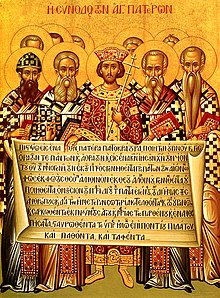
An Eastern Christian icon depicting Emperor Constantine and the Fathers of the First Council of Nicaea (325) as holding the Niceno–Constantinopolitan Creed of 381.
Its main points include:
- belief in God the Father, Jesus Christ as the Son of God and the Holy Spirit
- the death, descent into hell, resurrection, and ascension of Christ
- the holiness of the Church and the communion of saints
- Christ's second coming, the Day of Judgement and salvation of the faithful.
The Chalcedonian Definition, or Creed of Chalcedon, developed at the Council of Chalcedon in 451,[33] though rejected by the Oriental Orthodox Churches,[34] taught Christ "to be acknowledged in two natures, inconfusedly, unchangeably, indivisibly, inseparably": one divine and one human, and that both natures, while perfect in themselves, are nevertheless also perfectly united into one person.[35]
The Athanasian Creed, received in the Western Church as having the same status as the Nicene and Chalcedonian, says: "We worship one God in Trinity, and Trinity in Unity; neither confounding the Persons nor dividing the Substance."[36]
Most Christians (Roman Catholics, Eastern Orthodox, Oriental Orthodox and Protestants alike) accept the use of creeds, and subscribe to at least one of the creeds mentioned above

No comments:
Post a Comment